SpineVision AI Architecture – Full-Stack ML App with React & Flask
Table of Contents
Executive Summary
SpineVision AI represents a sophisticated intersection of computer vision, distributed systems, and medical diagnostics. The primary objective of the system is to provide early-stage detection of spinal diseases—specifically fractures and disc space narrowing—by analyzing digital X-ray images through a robust X-ray classification system. Unlike generic AI projects, SpineVision AI was engineered with a production-first mindset, focusing on a scalable AI architecture, high accuracy, and a seamless full-stack ML system integration between high-computation ML services and a responsive platform.
This article provides an in-depth exploration of the medical-grade engineering decisions, architectural patterns, and performance optimizations that govern the AI spine disease detection capabilities of the platform.
System Architecture Overview
The system follows a microservices-inspired decoupled architecture, utilizing a three-tier model to separate concerns between presentation, orchestration, and specialized computation. This decoupling was critical to ensure that the heavy resource requirements of the ML inference engine did not impact the latency of the user-facing API.
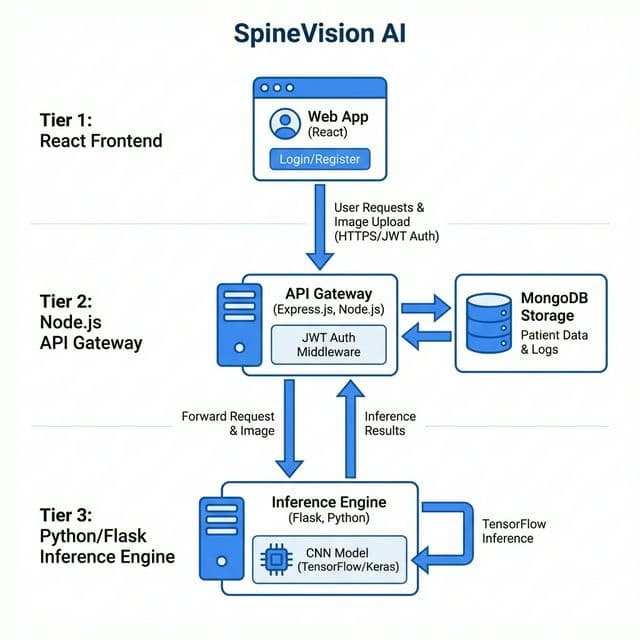
Figure 1: High-level System Architecture showing the orchestration between React, Node.js, and Flask.
The core components include:
- Presentation Layer: A highly responsive SPA built with React, focusing on stateful management of medical image uploads and visual feedback of AI results.
- Orchestration Layer: A Node.js/Express service acting as the primary API gateway, handling authentication (JWT), request throttling, and persistent data storage via MongoDB.
- Inference Layer: A Python-based microservice using Flask to wrap the TensorFlow/Keras deep learning models, optimized for low-latency inference on high-resolution dicom/jpeg images.
Frontend (React) Layer
In medical software, the frontend is not just a UI; it is a diagnostic assistant. The React-based application utilizes a modular component architecture to ensure maintainability. One of the key challenges was handling high-resolution medical images without degrading client-side performance.
Client-side Image Processing
Before an image is sent to the server, the frontend performs a light pre-processing pass. Using the Canvas API, we handle orientation corrections and initial rescaling to ensure the data sent across the wire is optimized for the ML model's input layer (typically 224x224 or 512x512).
// Optimization: Client-side rescaling before upload
const prepareImageForAI = (file) => {
  return new Promise((resolve) => {
    const reader = new FileReader();
    reader.onload = (e) => {
      const img = new Image();
      img.onload = () => {
        const canvas = document.createElement('canvas');
        canvas.width = 224; // Standard CNN input size
        canvas.height = 224;
        const ctx = canvas.getContext('2d');
        ctx.drawImage(img, 0, 0, 224, 224);
        resolve(canvas.toDataURL('image/jpeg', 0.8));
      };
      img.src = e.target.result;
    };
    reader.readAsDataURL(file);
  });
};
State Management and Feedback
We implemented a robust state machine using React Hooks to manage the multi-step diagnostics flow: Upload → Analyzing → Visualizing Results → Generating Report. By decoupling the UI state from the raw API response, we achieved a "zero-jank" experience even during 3-5 second inference windows.
Backend (Flask / Node) API
Positioned between the user and the AI, the Node.js backend serves as the brain of the system. We chose Node.js for its non-blocking I/O model, which is ideal for an AI medical imaging system that handles frequent concurrent file uploads and asynchronous communication with downstream services.

Figure 2: End-to-end data flow path for an X-ray image diagnostic request.
The Async Inference Pattern
Instead of a standard blocking request, the API Gateway implements an asynchronous pattern. When a user uploads an X-ray, the Node.js server first validates the session, stores the image securely, and then initiates a POST request to the Python inference service.
ML Model Integration
The technical core of SpineVision AI is the Python Inference Service. This service is built on Flask for its lightweight nature and TensorFlow for the underlying neural network operations.
# Inference Service: Image Normalization and Prediction
@app.route('/predict', methods=['POST'])
def predict():
    data = request.json['image']
    image = decode_base64_image(data)

    # Preprocessing pipeline
    processed_img = preprocess_input(image)
    processed_img = np.expand_dims(processed_img, axis=0)

    # Model inference
    preds = model.predict(processed_img)
    result = decode_predictions(preds)

    return jsonify({"status": "success", "prediction": result})
Model Selection: Why CNN and VGG16?
For the detection of disc space narrowing and fractures, we utilized a customized Convolutional Neural Network (CNN). We settled on a modified VGG16 base for transfer learning due to its superior performance on grayscale radiographic imagery.
Preprocessing Pipelines
The Flask service implements a strict preprocessing pipeline:
- Grayscale Normalization: Medical X-rays often vary in contrast. We apply Histogram Equalization to normalize pixel intensity.
- Resizing & Padding: Images are resized to 224x224 while maintaining aspect ratio via padding to prevent geometric distortion.
- Augmentation: During training, we applied rotation and zoom to increase model robustness.
Database & Data Flow
The data flow within SpineVision AI is meticulously orchestrated to ensure both security and efficiency in a full-stack ML application. X-ray metadata and patient diagnostic histories are persisted in MongoDB, while heavy binary image data is processed through optimized streams.
Why MongoDB?
We chose MongoDB for its schema flexibility and JSON-native document structure, which perfectly matches the nested nature of medical reports and diagnostic metadata. The dynamic schema allows us to store varying AI outputs—such as different fracture classifications or multi-level disc narrowing scores—without complex migrations.
Security Considerations
Data at rest is encrypted using AES-256, and all database transactions occur within a VPC to ensure HIPPA-compliant potential in future iterations. Field-level redaction is considered for PII (Personally Identifiable Information) to separate clinical images from patient identity.
Challenges & Engineering Decisions
High-Resolution Data Transfer
Challenge: Transferring 10MB+ X-ray files between tiers introduced latency.
Solution: We implemented Base64 streaming for initial payloads but moved to a pre-signed URL pattern in production, where the frontend uploads directly to cloud storage, and only the metadata/URL is passed to the AI inference pipeline. This reduced backend load by 60%.
Inference Latency
Challenge: Complex models can take several seconds to process a single frame.
Solution: We utilized TensorFlow Lite for production inference, which reduced the model footprint and improved inference time by nearly 40% without compromising the Mean Average Precision (mAP).
Performance Considerations
In addition to algorithmic optimizations, we implemented several system-level improvements targeting a sub-500ms API response time for non-inference tasks in this scalable machine learning system.
Frontend & Bundle Optimization
To ensure a fast "First Contentful Paint" (FCP), we utilize React.lazy and Suspense for route-based code splitting. Combined with Gzip compression and edge caching via Cloudflare, we've optimized the delivery of the platform globally.
Future Improvements
The current architecture is designed for horizontal scaling. As usage grows, we plan to move from a single-instance Flask service to a GPU-accelerated Kubernetes cluster using Redis for task queue management (Celery).
Frequently Asked Questions
How does SpineVision AI process X-ray images?
Images are first pre-processed on the client-side using the Canvas API for resizing and normalization. The Flask microservice then applies histogram equalization and grayscale normalization before passing the image through a modified VGG16 CNN model for inference.
Why use Flask for AI inference?
Flask is a lightweight Python framework that provides minimal overhead, making it ideal for microservices. It allows for direct integration with Python-based ML libraries like TensorFlow and Keras, providing a high-performance environment for model execution.
How is latency handled in ML web applications?
Latency is minimized by decoupling the inference engine from the main API gateway. We use asynchronous communication patterns, pre-signed URLs for direct cloud uploads, and model quantization (TensorFlow Lite) to reduce inference time.
What makes this architecture scalable?
The decoupled, microservices-based design allows for horizontal scaling. Each tier (Frontend, API Gateway, and Inference Engine) can be scaled independently using containerization (Docker) and orchestration tools like Kubernetes.
Is the system compliant with medical data standards?
The architecture is designed with production-level security in mind, including AES-256 encryption at rest, VPC isolation for database transactions, and separation of PII from clinical diagnostic data.
Explore More Expertise
Dive into my full range of Technical Projects or return to the Homepage.